
Digital freight matching in Saudi Arabia is shifting from experimentation to execution. Ken Research values the Saudi Arabia digital freight matching market at USD 930 million based on a five-year historical analysis, and describes a move toward platforms that raise transparency, optimize load utilization, and reduce operational costs. The same source highlights platform capabilities such as real-time tracking, AI-based freight matching, and expanded value-added services for shippers and carriers. This matters in a haulage market where demand is broad, from retail to heavy industry, and where digitally coordinated capacity can reduce friction between shippers that want certainty and carriers that want consistent utilization.
City concentration is a key early consolidation mechanism. Ken Research points to Riyadh, Jeddah, and Dammam as dominant nodes for digital freight matching due to strategic locations, infrastructure, and logistics-company concentration. These hubs are also where route density makes marketplace economics work: more shippers and trucks create faster matching and better service reliability. Mordor Intelligence adds a cost signal tied to geographic dispersion, noting that e-commerce delivery per-package cost outside the Riyadh–Jeddah–Dammam triangle runs 15–20% above GCC averages due to longer routes and sparse drop density. Platforms can use pooling, better dispatching, and visibility tools to help carriers serve these tougher lanes with fewer wasted miles.
Why Marketplaces Are Consolidating a Fragmented Haulage Base
Regulation and data availability are pushing the market toward standardized, platform-led execution. Ken Research notes that in 2023 the Saudi government implemented regulations to promote digital transformation in logistics, referencing the National Transport and Logistics Strategy issued by the Ministry of Transport and Logistics Services in 2021. The same description says the approach mandates adoption of digital platforms for freight matching, sets operational standards for platform providers, and requires compliance with data transparency and electronic documentation for logistics transactions. Mordor Intelligence adds an enabling layer: mandatory telematics on commercial vehicles from January 2025 creates data flows that support predictive maintenance and compliance monitoring. Together, these measures make it easier for marketplaces to scale consistent processes across many carriers.
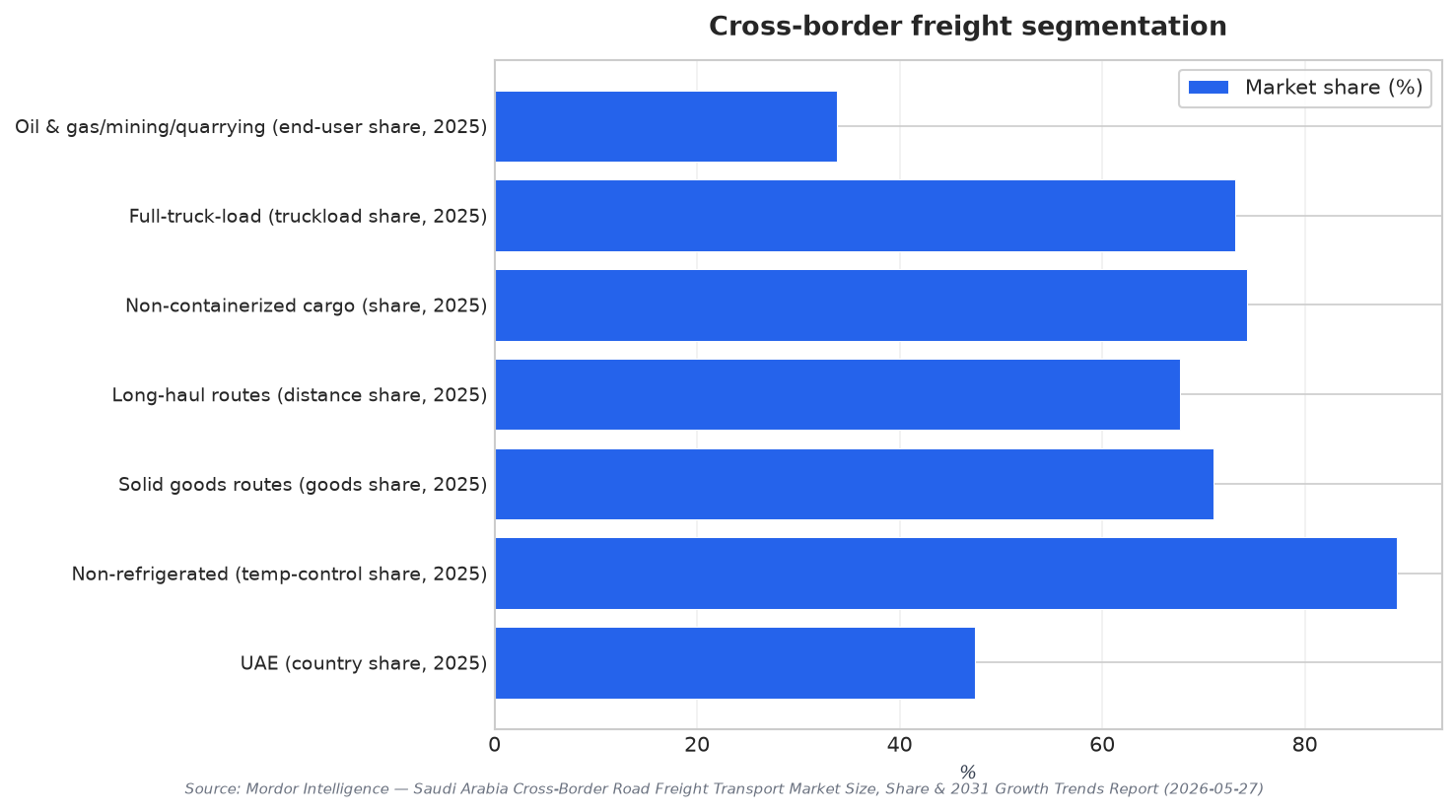
Marketplaces are also consolidating around the largest freight flows and the most common operating models. In Saudi Arabia’s cross-border road freight transport market, Mordor Intelligence values the market at USD 2.57 billion in 2025 and estimates growth from USD 2.65 billion in 2026 to USD 3.54 billion by 2031, at a 5.96% CAGR (2026–2031). In 2025, full-truck-load held 73.11% share, long-haul routes accounted for 67.72%, and non-containerized cargo led with 74.3%. These structures favor marketplaces that can aggregate capacity for FTL and long-haul while layering tracking and documentation to meet shipper expectations. At the same time, the report notes LTL is forecast to grow at a 7.73% CAGR through 2031, which supports platforms built to orchestrate partial loads and dynamic routing.
Adoption signals show both momentum and remaining fragmentation, which is exactly the gap a Saudi digital freight platform trucking marketplace tries to close. A global digital freight matching report cites the Middle East & Africa handling 210,000 matches in 2023, with 140,000 in UAE/Saudi Arabia. The same source describes a fragmented landscape with over 480 small digital brokers operating in regional pockets, and notes that many small carriers, especially those with fewer than 5 trucks, report discomfort using digital-only platforms. In Saudi Arabia’s broader trucking environment, Ken Research values the freight trucking market at USD 6.7 billion, and also states logistics sector demand is projected to reach SAR 120 billion in future, supported by a population of approximately 35 million and urbanization rates exceeding 83%. Marketplaces that standardize workflows and build trust can translate this demand into repeatable, network-driven hauling.
What is the current value cited for Saudi Arabia’s digital freight matching market?
Which Saudi cities are highlighted as key hubs for digital freight matching?
How do regulations support trucking marketplaces in Saudi Arabia?
What do the sources say about cross-border road freight structure in 2025?
How is a Saudi digital freight platform trucking marketplace connected to regional adoption trends?