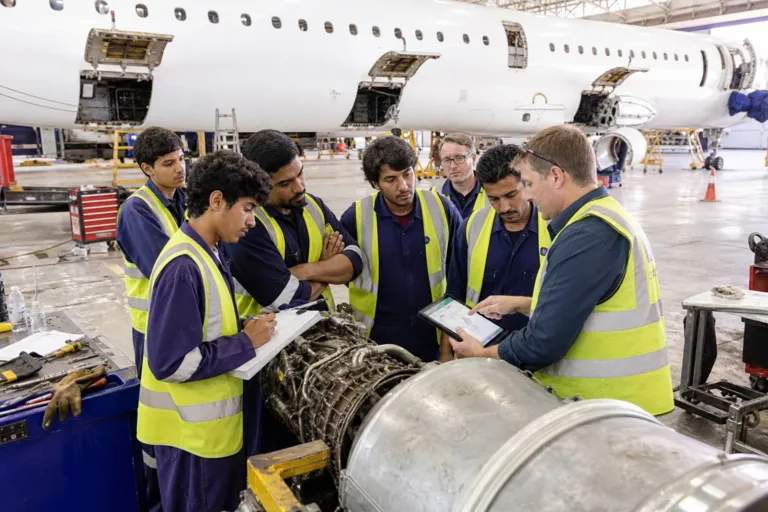
Saudia Technic is sharpening its workforce pipeline as part of a broader MRO push, and that focus is central to the Saudia Technic MRO expansion 2026 conversation. The company sent 40 young men and women to the U.S. to jump-start their careers in aviation maintenance through a partnership with Spartan College of Aeronautics and Technology. This initiative is framed as a workforce response tied to Saudi Arabia’s Vision 2030 plans, which will invest billions into the country’s aviation ecosystem as part of wider modernization goals and efforts to attract visitors.
The workforce thread is not new for Saudia Technic. The company welcomed its first cohort of female trainees to its “Future Technic” AMT program in 2024. It has also signed several training-focused memoranda of understanding in recent years with schools in Saudi Arabia. Those include Effat University, Princess Nourah University, the University of Business and Technology and the University of Jeddah. Taken together, the message is clear: the MRO push is being built on training capacity, structured entry paths, and formal education links.
Building a Hub Needs People, Partners, and Network Pull
Saudi Arabia’s aviation activity and connectivity context matters because it shapes demand signals for maintenance and training. Aviation Week reported Saudi Arabia strengthening its global air network with 17 deals. Separately, Aviation Week also reported a mega terminal plan in Riyadh intended to handle 40 million passengers. These figures are not MRO volumes. But they illustrate the scale of aviation system-building happening around airlines, airports, and cross-border links. For an MRO player, that environment can increase the importance of locally available, globally benchmarked maintenance talent.
Competition across the region and nearby markets also shows why capability-building can be a differentiator. Safran started work on a new Leap engine MRO facility in Casablanca spanning 25,000 m2 and designed to handle 150 engines per year. The project is projected to create 600 new jobs by 2030, representing an investment of approximately €120 million ($139 million). In the UAE, Sanad is building a GTF MRO shop in Al Ain under a 30-year agreement with Pratt & Whitney signed in February 2025, with capacity to handle 350 engines annually once operational in Q3 2028.
Sanad’s plans also include test infrastructure. Its Al Ain site is described as operating two large test cells with capacity for 500 tests annually, and another report says the completed 2028 site will operate twin test cells capable of conducting more than 500 engine tests annually. In 2025, Sanad invested more than AED 100 million to expand shop floor capacity and repair capabilities. Saudia Technic’s story in the provided sources is not about test-cell counts or engine-throughput targets. It is about building the human foundation to compete in a region where other players are advertising large, measurable capacity and investment commitments.
That is why the training pipeline is a strategic MRO lever, not a side project. Sending 40 trainees to the U.S. signals an intent to accelerate readiness and exposure to established training pathways, while local MOUs anchor a longer-term domestic supply of technicians. The 2024 “Future Technic” milestone adds a workforce inclusion marker alongside volume-building. For Saudia Technic MRO expansion 2026, the practical takeaway is that globally competitive hubs are built through repeatable talent systems, and the company is using partnerships to make that system real.
What is Saudia Technic doing in Saudia Technic MRO expansion 2026?
How does Saudia Technic link its training push to Vision 2030?
When did Saudia Technic welcome its first cohort of female trainees?
Which Saudi universities are named in Saudia Technic training MOUs?
What nearby MRO expansions show the competitive backdrop?